
Updated September 9, 2026 by Radiant Life Omaha.
When focus, worry, big feelings, sleep, school stress, and sensory input all seem tangled together, one behavior is not enough to label a child. Start by tracking the pattern: what happened before the hard moment, what your child did, how long recovery took, what helped, and whether the same pattern shows up at school, bedtime, transitions, homework, or crowded places.
That pattern will not diagnose ADHD, anxiety, autism, a learning disorder, a sensory processing condition, or anything else. It can give Omaha parents a clearer next conversation and a better way to decide what support belongs in the room.
The quick answer
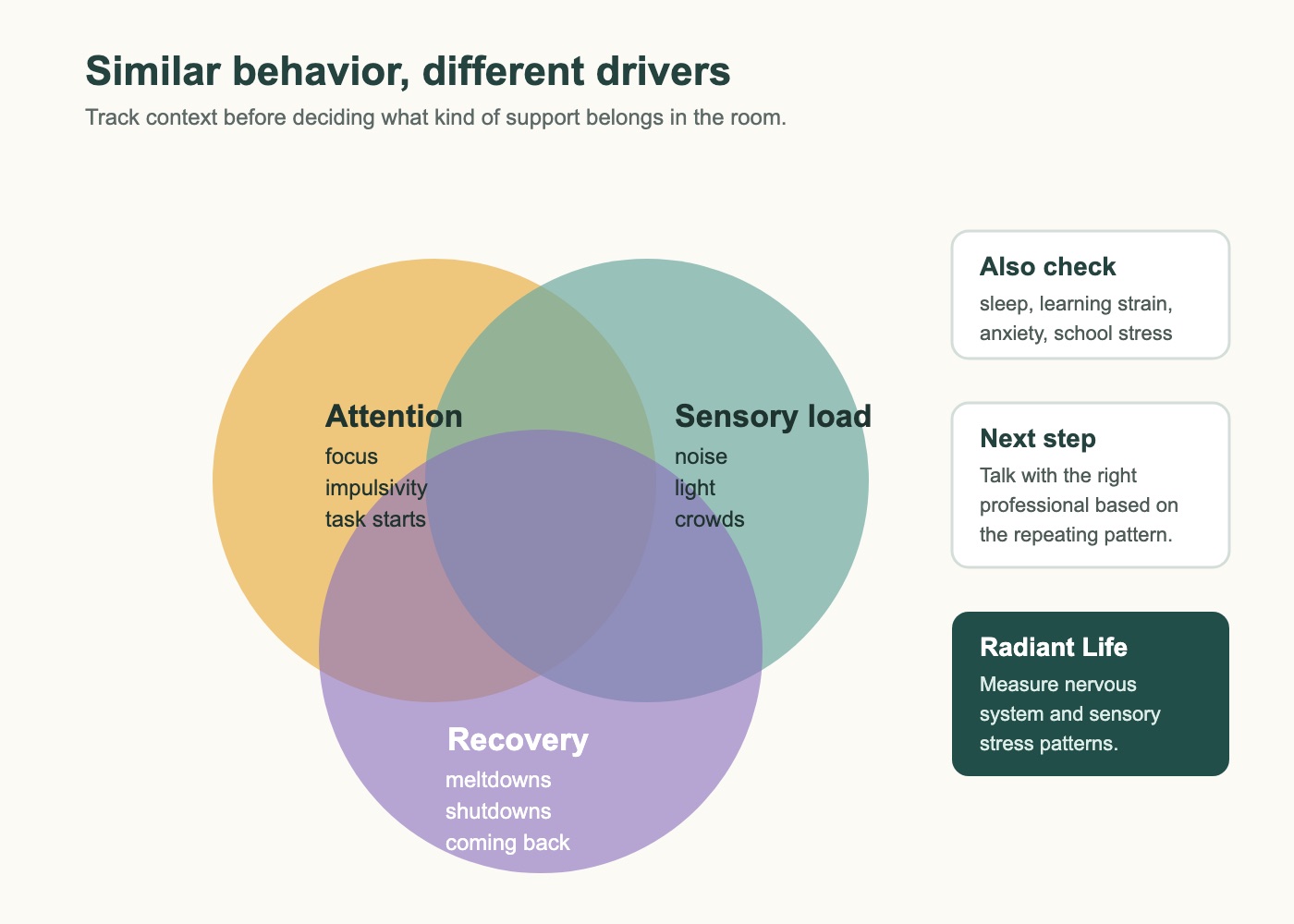
ADHD, anxiety, sleep problems, school stress, learning strain, and sensory overload can look similar from the outside. A child might melt down, refuse, run away, argue, freeze, lose focus, act silly, get loud, hide, or seem impossible to reach.
That does not mean the child is lazy, spoiled, manipulative, or choosing to make life hard. It also does not mean the parent has failed. It means the behavior needs context.
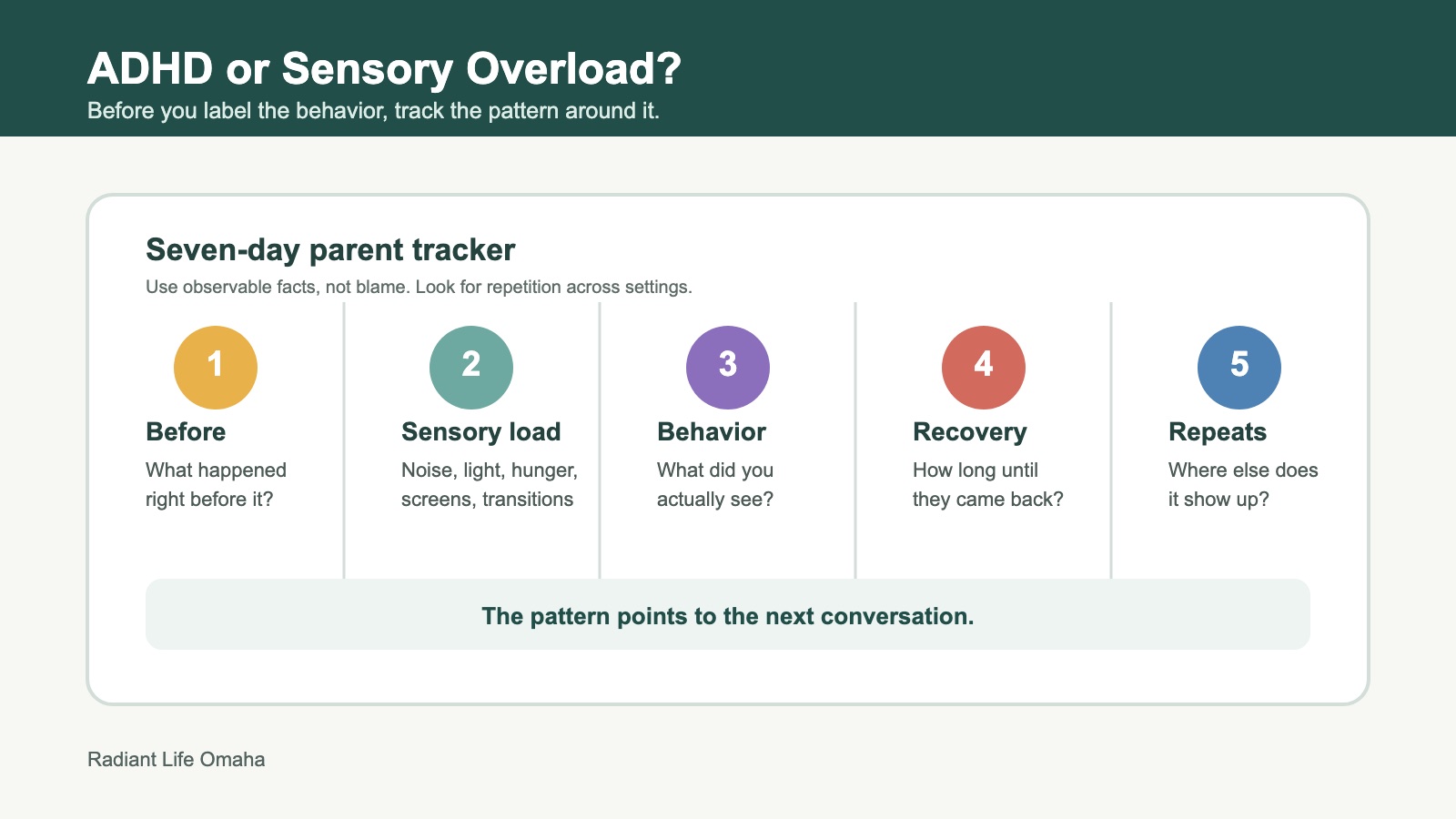
For the next seven days, track five things:
- What happened right before the hard moment.
- What sensory load was present, including noise, lights, crowds, clothing, smells, hunger, fatigue, screens, or transitions.
- What the behavior looked like.
- How long recovery took.
- What actually helped your child come back.
If the same pattern keeps repeating, you have something more useful than a label. You have a map.
Why symptoms can overlap
The CDC says diagnosing ADHD is a multi-step process, and there is no single test for ADHD. The CDC also notes that sleep disorders, anxiety, depression, and some learning disabilities can have symptoms that look similar to ADHD. That is why a qualified evaluation looks across settings and asks about home, school, peers, medical history, vision, hearing, and other possible explanations.
Parents feel the overlap before they know the words for it.
A child who cannot filter noise may look defiant in a restaurant. A child who is exhausted may look impulsive after school. A child who does not understand directions may look avoidant at homework time. A child who is anxious may look controlling, argumentative, or shut down. A child whose body is overloaded may hear “calm down” and still be unable to calm down.
This is why the first question should not be, “What is wrong with my child?”
A better first question is, “What pattern is my child showing us?”
What to track before deciding what it means
Keep the tracker simple enough to use on a real school night. You do not need a perfect chart. You need repeatable observations.
1. What happened before it started?
Write the moment down as plainly as possible:
- We got home from school.
- I asked him to start homework.
- Her sister turned on the TV.
- We walked into a loud gym.
- He had to put on socks.
- Bedtime started ten minutes late.
- The teacher sent home missing work.
The “before” matters because many children do not go from fine to furious for no reason. Their system may already be full.
2. What sensory load was present?
Notice the things adults often tune out:
- Noise.
- Bright light.
- Crowds.
- Clothing tags or seams.
- Hunger or thirst.
- Screens or fast transitions.
- Smells.
- Heat.
- Visual clutter.
- A long stretch of sitting still.
You are not trying to prove that every behavior is sensory. You are asking whether sensory load is part of the pattern.
3. What did the behavior actually look like?
Use observable words. Instead of “bad attitude,” write what happened.
- Covered ears.
- Hid under the table.
- Started pacing.
- Cried for 18 minutes.
- Ran to another room.
- Yelled, “I cannot do this.”
- Tore the worksheet.
- Refused shoes.
- Asked the same question over and over.
Clear language helps everyone talk about the same thing.
4. How long did recovery take?
Recovery is often more revealing than the first outburst. Did your child come back in two minutes, twenty minutes, or two hours? Did they need quiet, movement, pressure, food, sleep, space, connection, or a smaller first step?
If recovery is slow, daily, or getting worse, it is worth bringing in qualified support.
5. Where else does it show up?
One hard moment does not tell the whole story. Look for repeated patterns across:
- School mornings.
- After-school crashes.
- Homework.
- Bedtime.
- Sports or church.
- Stores and restaurants.
- Clothing, grooming, or hygiene.
- Transitions away from screens.
The goal is not to diagnose from a blog post. The goal is to stop guessing from one behavior.
What not to assume
Do not assume your child is doing it on purpose just because the behavior is inconvenient. Do not assume better parenting alone will solve it just because someone else thinks your child “needs more discipline.” Do not assume medication is the only possible lane. Do not assume medication is the wrong lane either.
The CDC describes ADHD treatment as something that may include behavior therapy, parent training, medication, school supports, and close monitoring, depending on age and need. Some families use medication. Some families prefer a non-medication route. Some use therapy, school services, occupational therapy, lifestyle changes, and nervous system support together.
The right next step depends on the child, the family, the setting, and the pattern.
When to bring in support
If there is danger, self-harm, threats of harm, or a crisis, use emergency support immediately. In the United States, families can call or text 988 for mental health crisis support, and call 911 for immediate danger.
For non-emergency concerns, talk with your child’s pediatrician or another qualified professional when the pattern is persistent, intense, or affecting sleep, eating, school, friendships, safety, or daily family life. The National Institute of Mental Health encourages families to seek help when emotional or behavioral concerns interfere with daily life, relationships, school, or safety. Ask the school what they are seeing. If learning, speech, occupational therapy, anxiety, trauma, sleep, or medical concerns may be involved, those conversations matter.
Getting help does not mean you are overreacting. It means you are done guessing alone.
Where Radiant Life Omaha fits
Radiant Life Omaha is for parents who are ready to take action and want hope with useful answers. Many parents who call us are looking for a non-medication route, or they have tried therapy, tutoring, stricter routines, better parenting strategies, or school conversations and still feel something deeper may be driving the pattern.
Our role is to help parents understand whether nervous system stress, sensory overwhelm, and brain-body communication may be part of the picture. We measure. We look for patterns. We explain what we find in plain language. We guide next steps and track change over time.
That does not replace your pediatrician, therapist, school team, occupational therapist, medication provider, or emergency support when those are needed. For some families, Radiant Life Omaha can be a primary clarity step. For others, it works alongside the care and resources already in place.
If your child is trying and still stuck, that is exactly the kind of pattern worth investigating.
FAQ
Can sensory overload look like ADHD?
It can overlap from a parent’s point of view. Trouble with focus, impulsive-looking behavior, meltdowns, avoidance, and emotional recovery can have more than one possible driver. A qualified evaluation is needed for diagnosis, and pattern tracking can make that conversation clearer.
Should I stop medication or therapy while exploring sensory or nervous system support?
No. Do not stop or change medication without talking with the prescribing clinician, and do not stop therapy or school supports just because you are exploring another angle. Radiant Life Omaha can be considered alone or alongside other appropriate care.
What should Omaha parents track first?
Track the moment before the behavior, sensory load, what the behavior looked like, recovery time, and what helped. After a week, look for repeated patterns instead of judging one hard moment.
Is this only for parents who already know the diagnosis?
No. This is also for parents who are still trying to understand what is happening. The tracker is meant to help you walk into the next conversation with clearer observations.
When is it urgent?
If there is self-harm, threats of harm, danger, panic that feels unmanageable, or a major change in safety or functioning, seek urgent help. Call or text 988 for mental health crisis support in the United States, call 911 for immediate danger, or contact your child’s healthcare provider for medical concerns.
A calmer next step
If you are near Omaha and you are tired of trying to decide whether this is ADHD, anxiety, sensory overload, behavior, sleep, school stress, or something else, give us a call. We can help you look at the pattern, understand what your child’s system may be communicating, and decide the next right step.
You can also start with Radiant Life Omaha’s ADHD resources, sensory system answers, ADHD and sensory processing research article, or new patient information if you want to read more before reaching out.
