
If your child can focus on a game but falls apart over homework, do not start with lazy or bad attitude. Start with the pattern.
When does focus disappear? What happened right before the meltdown? Is the room loud, the clothing uncomfortable, the transition too fast, the school day too long, or the demand bigger than their system can handle?
Omaha parents often ask this question with a knot in their stomach: is this ADHD, anxiety, a sensory problem, or something else? From the outside, those struggles can look similar. A child may avoid schoolwork, melt down when plans change, lose focus, argue over small tasks, or recover slowly after an ordinary day.
The better first move is not to label the child from one behavior. The better first move is to measure what keeps repeating.
Why the same child can focus sometimes and not other times
Attention is not only about effort. Kids can often focus longer on something that is interesting, predictable, fast-moving, or rewarding. Homework, transitions, chores, clothing, noise, hunger, fatigue, and school pressure ask something different from the brain and body.
That does not mean a child is choosing chaos. It may mean the nervous system is already working hard before the parent ever says, “Please start your homework.”
ADHD, anxiety, sleep problems, learning stress, and sensory overload can overlap in real life. A child may have a diagnosis and still need a better map of the daily pattern. Another child may not have a diagnosis, but the family still needs clarity because the home is running on survival mode. For more local context, parents can also read Radiant Life Omaha’s ADHD resources and sensory system answers.
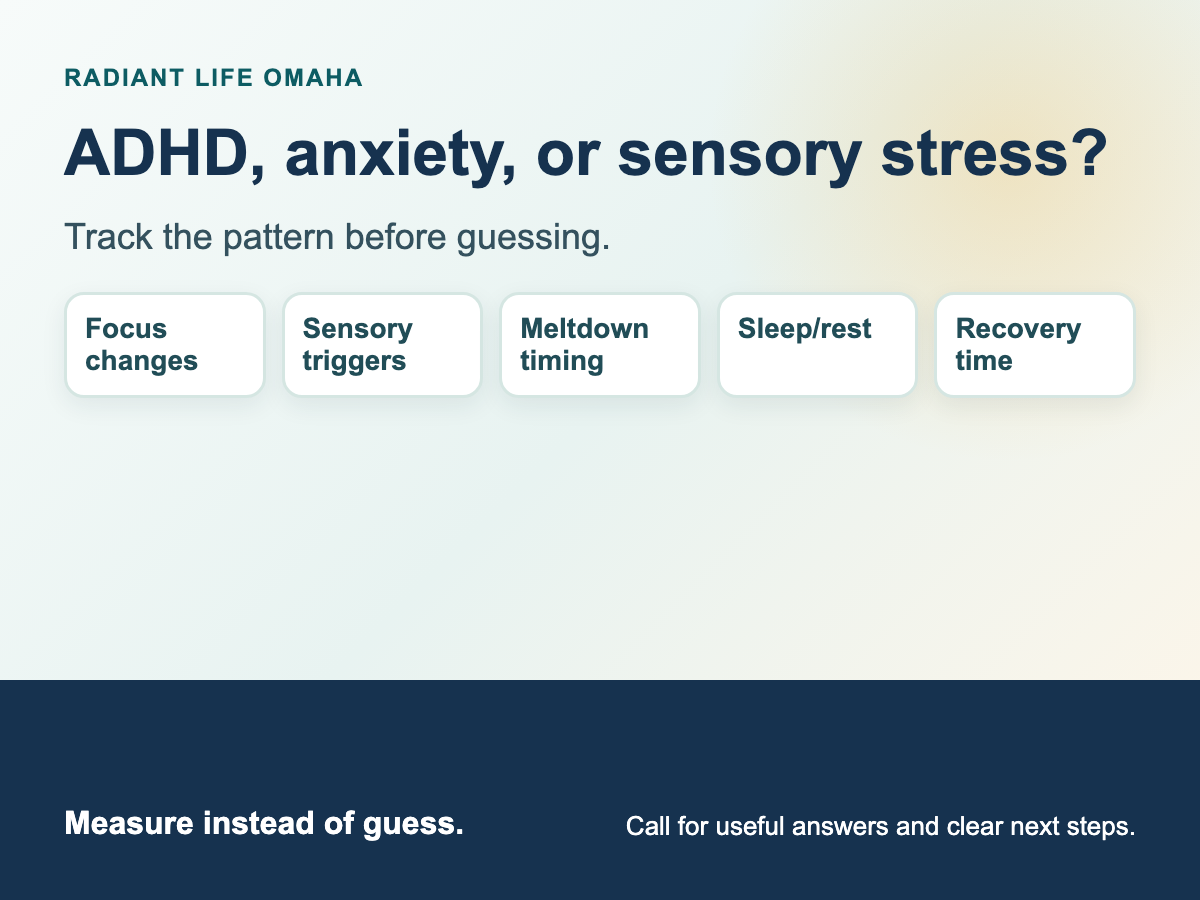
Five clues to track before you guess
- Focus changes: When does focus seem easier? When does it vanish? Notice time of day, type of task, environment, and whether the child is hungry or tired.
- Sensory triggers: Track noise, clothing, lights, crowds, smells, food texture, body movement, and screen transitions.
- Meltdown timing: Notice whether the hardest moments happen before school, after school, during homework, before bed, or after a busy weekend.
- Sleep and rest: Record bedtime, wake time, night waking, morning energy, and whether the child seems wired and tired.
- Recovery time: How long does it take to return to calm? What actually helps: pressure, quiet, movement, food, connection, or a smaller first step?
What this can reveal
A focus struggle that happens mainly after school may point to a child who has spent the whole day holding it together. A homework battle that begins before the pencil touches the paper may point to too many hidden steps. A child who melts down over socks, tags, noise, lights, or transitions may be showing signs that the sensory system is under stress.
Sometimes the next step is a school conversation. Sometimes it is a pediatrician, therapist, occupational therapist, counselor, or medication conversation. Sometimes it is a better home rhythm. And for some families, it is time to measure whether sensory and nervous-system stress is part of the puzzle.
How Radiant Life Omaha fits
Radiant Life Omaha believes God made the body to work properly and to know peace and joy. When a child is overwhelmed, the goal is not blame. The goal is understanding.
Radiant Life Omaha helps parents measure instead of guess, identify sensory and nervous-system stress patterns, help calm the sensory system and brain, track whether daily life improves, and guide the next step. Amount and timing of improvement vary and cannot be guaranteed. Parents who want to understand the process before calling can read the new-patient information.
If Radiant Life Omaha is part of the answer, the team will walk with you. If it is not the right fit, the consultation should still help you leave with clearer direction.
When to call
Call when the pattern keeps repeating, when the whole family is walking on eggshells, when schoolwork or daily routines are taking over the home, or when you are tired of guessing.
Frequently asked questions
Can sensory stress look like ADHD or anxiety?
It can overlap from the outside. Focus struggles, avoidance, emotional outbursts, and shutdowns can have more than one contributing factor. That is why tracking patterns is useful before jumping to one explanation.
Should we stop other care while we figure this out?
No. Radiant Life Omaha’s parent education can sit alongside pediatric care, therapy, counseling, school support, medication conversations, and other appropriate resources.
What should I track first?
Start with focus changes, sensory triggers, meltdown timing, sleep/rest, and recovery time. Three to five days of notes can make the next conversation much clearer.
Helpful sources: HealthyChildren.org from the American Academy of Pediatrics ADHD overview; National Institute of Mental Health anxiety disorders information; Understood parent guidance on sensory processing challenges.
