

Updated September 2, 2026 by Radiant Life Omaha.
Homework refusal often starts before the pencil hits paper. A child may be trying to transition from school, organize materials, understand directions, choose a first step, tolerate mistakes, and keep going, all while tired or overloaded.
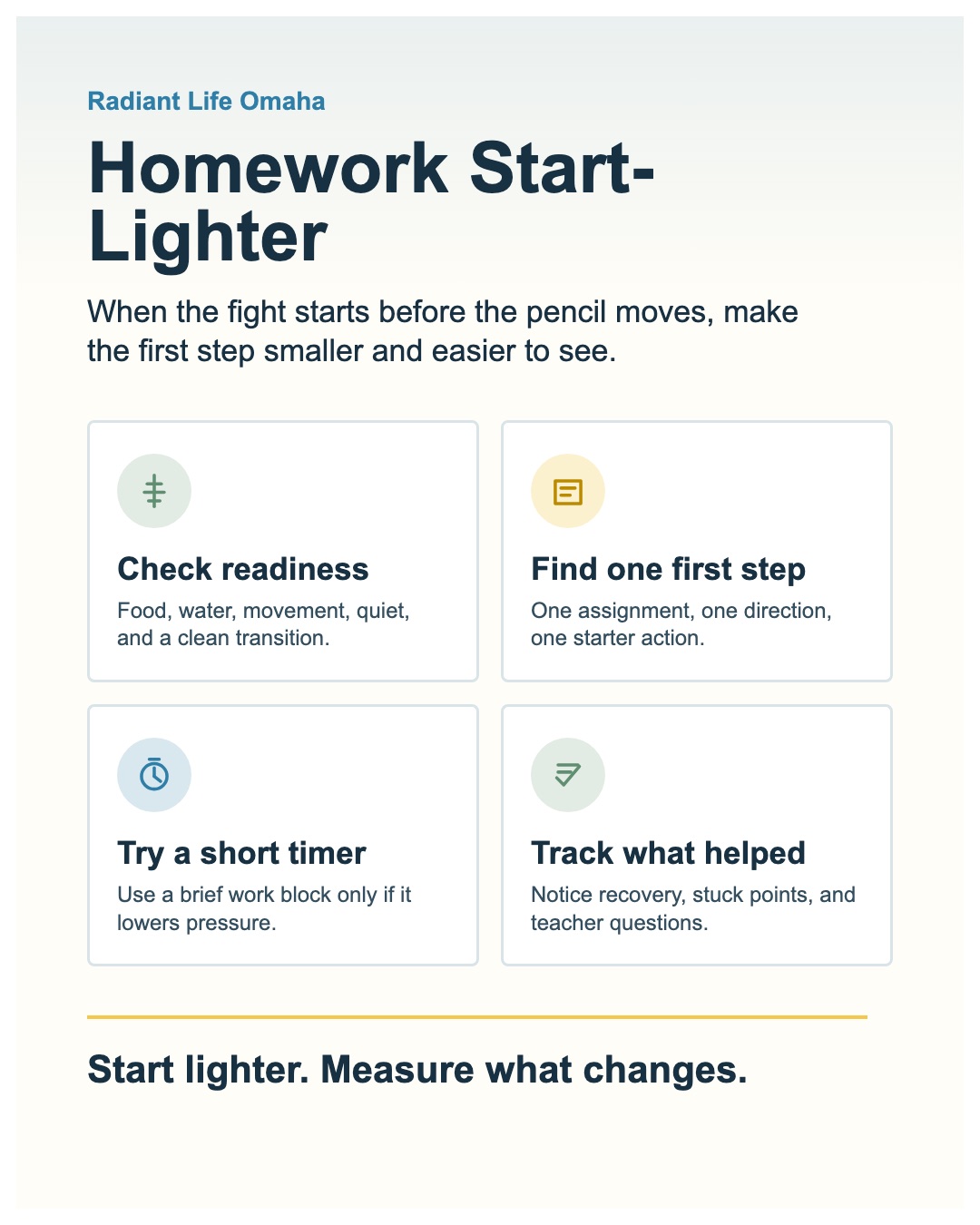
Start lighter before you judge the behavior. Check readiness, make one first step visible, use a short work-and-break rhythm if it lowers pressure, track what helped recovery, and talk with the teacher when the same stuck point keeps repeating.
This does not diagnose ADHD, anxiety, autism, a learning disorder, a sensory processing condition, or any other condition. It gives Omaha parents a calmer way to observe the pattern and decide what support conversation should happen next.
Why the fight starts so early
From the outside, homework can look simple. The backpack opens. The worksheet comes out. The parent says, “Let’s get started.” Then the child stalls, argues, shuts down, cries, gets angry, or says, “I can’t.”
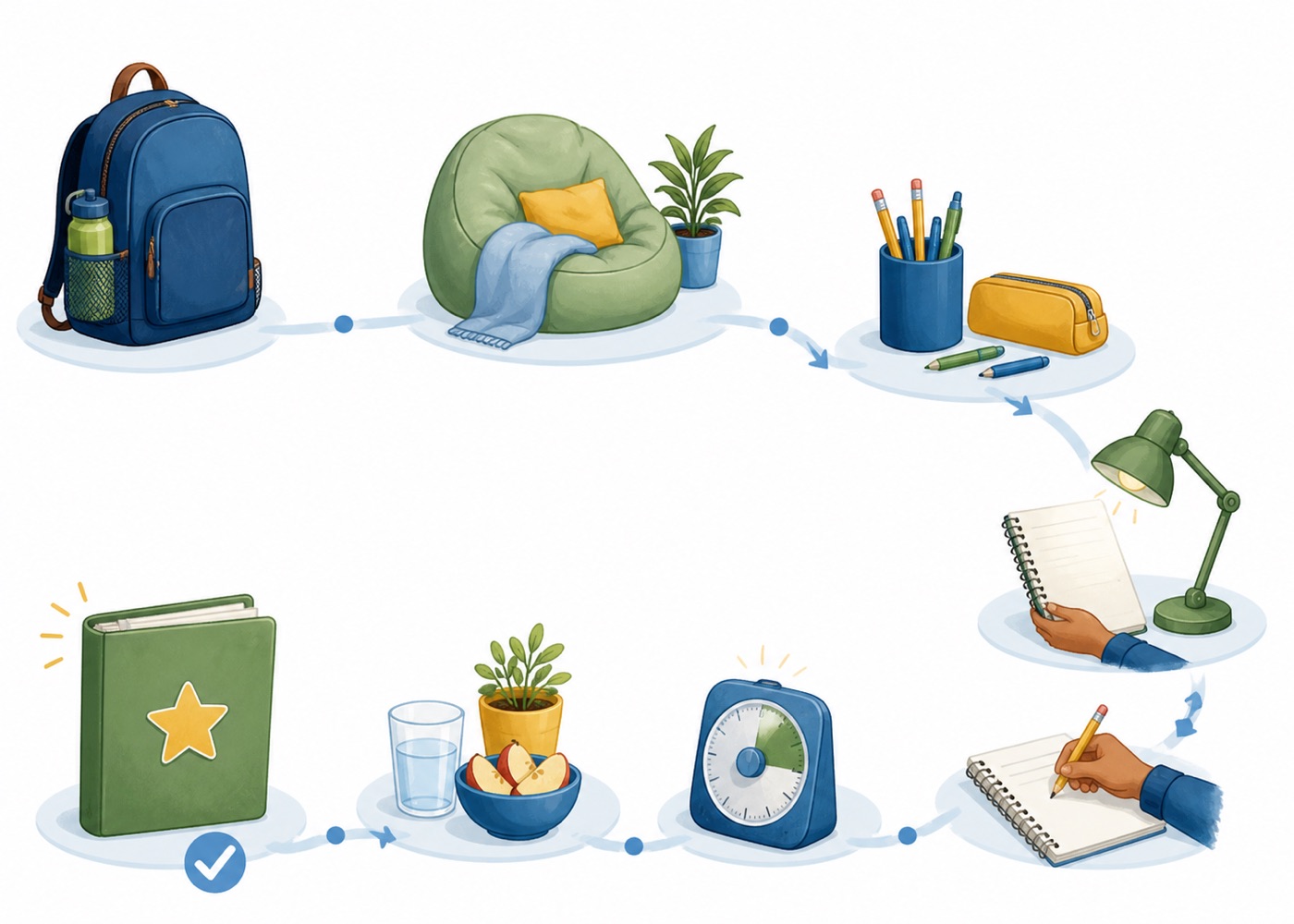
That moment can be confusing because the child may be bright, loving, and capable in other settings. The problem is that starting homework is not one task. It is a chain of smaller demands that can pile up quickly after a long school day.
- Stop what they were doing.
- Shift from school mode to home mode.
- Find the right folder, book, pencil, charger, or login.
- Understand what the teacher wanted.
- Choose the first action.
- Tolerate not knowing, making a mistake, or taking too long.
- Work long enough to build momentum.
- Put finished work where it needs to go tomorrow.
Friction anywhere in that chain can look like refusal. It should not be ignored, but it should be understood before it is labeled.
What current guidance supports
The CDC’s ADHD classroom guidance points to clear assignments, manageable task length, organizational tools, breaks, positive feedback, and regular parent-school communication for students with ADHD. The CDC treatment overview also notes that school-age treatment plans may include parent training, classroom support, organizational skills training, close monitoring, and adjustment over time.
CHADD’s homework guidance gives similar practical ideas: create a low-distraction homework space, keep needed materials ready, break assignments into manageable parts, use timers and breaks when helpful, give specific praise, adjust what is not working, and communicate with the teacher.
A 2026 Journal of School Psychology study of school-based organizational skills training found that improvements in organization, time management, and planning helped explain later homework improvement among upper elementary students with those difficulties. That study did not test Radiant Life Omaha or chiropractic care. It does support the parent-friendly idea that planning, organization, and getting started are worth looking at directly.
The boundary matters. None of this means every homework battle has the same cause. It means parents do not have to choose between blaming the child and guessing at a label. They can measure the start.
The Homework Start-Lighter experiment
Try this for five school days. Keep it simple enough that you can actually use it when the house is tired.
1. Check readiness first
Before homework starts, check the basics: food, water, bathroom, movement, noise, lighting, screen transition, and emotional load. Some children need ten quiet minutes. Some need a snack. Some need to move. Some need a parent nearby without being hovered over.
You are not trying to create a perfect routine. You are asking, “Is my child ready enough to begin, or are we asking for work before their system has shifted out of the school day?”
2. Make one first step visible
Do not start with the whole assignment. Start with one visible doorway into the work.
- Put one assignment on the table.
- Read one direction.
- Circle the first problem.
- Write the name at the top.
- Open the book to the right page.
- Read the first paragraph together.
That first step matters because many children are not refusing the entire assignment. They are stuck at the doorway.
3. Use a short timer only if it lowers pressure
A timer can help some children because it shows that work has an endpoint. For other children, a timer increases pressure. Start with a short block that your child can survive with some dignity, even if that is five minutes.
Then use a predictable break. Movement, water, a short reset, or a quiet pause may help. The point is not to negotiate forever. The point is to build a rhythm that helps your child return.
4. Track what helped recovery
The most useful question is not only, “Did the homework get done?” It is, “What helped my child come back after getting stuck?”
- Did food help?
- Did movement help?
- Did reading the directions out loud help?
- Did the first step need to be smaller?
- Did a break help or make it harder to return?
- Did one type of assignment create most of the fight?
A five-day tracker for parents
For five school days, write down only what you can actually see. Keep it short.
- Time of day.
- Sleep, hunger, illness, practice, screen time, or schedule changes.
- Assignment type: reading, writing, math, online work, project, studying, or missing work.
- How long it took to start.
- The smallest first step that worked.
- Work block length before frustration rose.
- Distress level from 0 to 5.
- What helped recovery.
- Question to ask the teacher.
After five days, look for patterns. Does writing create more friction than math? Does online homework create more conflict than paper? Does the battle happen mostly after late nights, noisy afternoons, or unclear directions? Does your child do better when the first step is visible?
Patterns give you better next steps than blame.
What not to assume
Do not label the whole child from one homework behavior. Homework refusal does not prove laziness, ADHD, anxiety, autism, sensory overload, a learning disability, bad parenting, or a bad teacher.
It is also possible for more than one thing to be true. A child can be tired and confused. A child can understand the math but panic over writing. A child can hold it together at school and then fall apart when the demands shift at home. A child can want to do well and still struggle to start.
That is why Radiant Life Omaha keeps coming back to the same first step: measure instead of guess.
When to contact the teacher
Contact the teacher when assignments are unclear, repeatedly missing, taking much longer than expected, or creating the same stuck point again and again.
- “What is the most important part of this assignment?”
- “How long should this normally take?”
- “Is my child missing directions, materials, or classroom support?”
- “Are you seeing the same stuck point at school?”
- “Would a checklist, chunked assignment, or clarification routine help?”
This is not about asking the school to remove every hard thing. It is about finding the first stuck point so the next support is more accurate.
When to seek qualified help
Ask for qualified help promptly if homework is connected with repeated panic, threats, self-harm statements, aggression, unsafe behavior, severe school avoidance, bullying concerns, medication concerns, major sleep or appetite changes, medical symptoms, or a clear decline in daily functioning.
Depending on the pattern, that may mean your pediatrician, a mental-health professional, the school support team, an occupational therapist, a learning specialist, or another appropriate provider.
Where Radiant Life Omaha fits
Radiant Life Omaha helps parents measure instead of guess. For families who are also seeing broader regulation patterns, sensory stress, transition struggles, focus battles, or “something feels off” moments, our team can help observe whether sensory-system stress and brain-body communication may be part of the puzzle within our scope.
Radiant Life Omaha does not diagnose a child from homework behavior. We do not claim chiropractic care treats, cures, prevents, or guarantees improvement in ADHD, anxiety, autism, meltdowns, executive function, sensory processing concerns, focus, homework, grades, or school performance.
The first step is clarity. If we are not the right fit, we will help you think through the next appropriate step.
You can learn more about our broader parent education on ADHD-related concerns, sensory-system answers, common parent questions, and the new patient process.
Get the Homework Start-Lighter tracker
Use the tracker for five school days: check readiness, find one first step, try a short timer if it lowers pressure, and track what helped your child recover.
If broader sensory, transition, focus, or regulation patterns are part of what you are seeing, take the 60-Second Sensory Quiz or contact Radiant Life Omaha to ask what next step makes sense for your family.
FAQ
Why does my child refuse homework before starting?
Homework can require transition, organization, planning, attention, frustration tolerance, and confidence before the first answer is written. If one part of that chain is overloaded, starting can feel too big. Refusal does not prove one diagnosis or one cause.
How do I help an ADHD child start homework?
Start with structure instead of pressure: reduce distractions, gather supplies, make one first step visible, use a short work block if it helps, give specific praise for starting, and coordinate with the teacher when the pattern repeats. For diagnosis or treatment decisions, work with qualified healthcare and school professionals.
Should I give a break before homework?
Often, yes. Some children need food, movement, quiet, or a short decompression window after school. Make the break predictable and then return to a small first step so the break does not become another conflict.
How long should a homework work block be?
Use the shortest block that helps your child experience a successful start. Some children can handle 20 minutes. Others may need five. The right length is the one that lowers pressure and helps your child return after a break.
When should I contact the teacher about homework battles?
Contact the teacher when directions are unclear, assignments are missing, the work takes far longer than expected, or the same stuck point appears repeatedly. Ask what is essential, how long it should take, and whether the same pattern shows up at school.
When should I ask for professional help?
Ask for qualified help promptly when homework struggles involve panic, threats, self-harm statements, aggression, unsafe behavior, severe school avoidance, bullying concerns, medication concerns, medical symptoms, major sleep or appetite changes, or a clear decline in daily functioning.
Sources
- CDC: ADHD in the Classroom, updated June 1, 2026.
- CDC: Treatment of ADHD, updated June 2, 2026 and reviewed July 30, 2026.
- CHADD: Homework Help for ADHD.
- Power TJ, et al. School-based organizational skills training for upper elementary students, Journal of School Psychology, 2026.
- Radiant Life Omaha: ADHD, Meltdowns, and Sensory Overwhelm: What New Research Shows.
