
If noise, clothing, transitions, crowds, or school demands send your child from fine to furious, the question is not only, “How do we stop this?” It is, “What is their system reacting to?”
Many Omaha parents start searching because the daily pattern no longer feels normal. Socks feel unbearable. A noisy restaurant is too much. The child melts down when plans change. Homework becomes a battle. Haircuts, clothing tags, school assemblies, bright lights, crowded stores, or bedtime routines suddenly become the thing the whole family has to plan around.
Those moments can feel dramatic from the outside. Inside the child, they may feel like overload.
What parents usually notice first
Sensory stress does not always look like a child covering their ears. It can look like anger, avoidance, silliness, shutdown, panic, refusal, clumsiness, constant movement, chewing, crashing, hiding, or needing a screen to recover.
No single behavior proves a sensory-processing diagnosis. But a repeating pattern can tell you that the child’s system is reacting to something worth understanding.
Seven red flags to track for five days
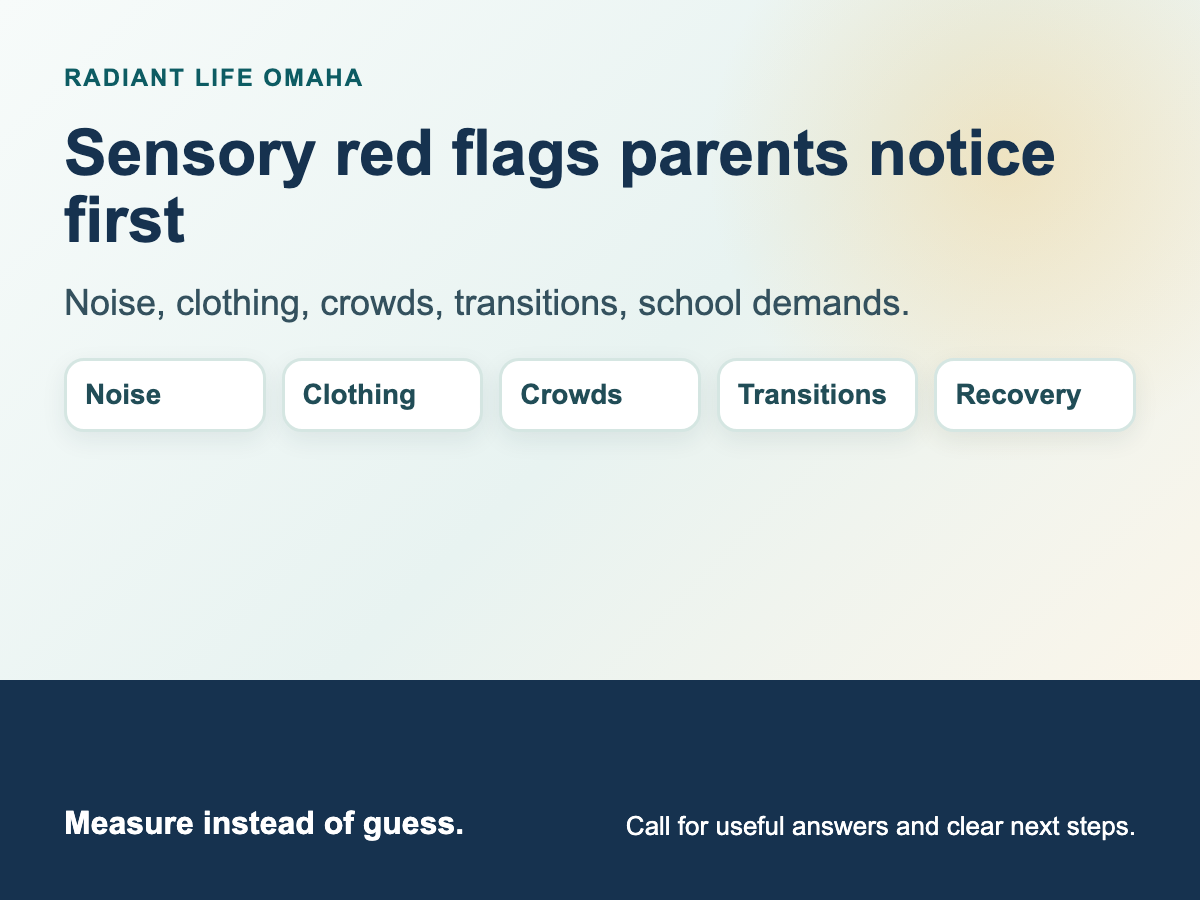
- Noise: covering ears, avoiding bathrooms, restaurants, gyms, assemblies, vacuums, or crowded rooms.
- Clothing and touch: sock seams, tags, waistbands, hair brushing, nail trimming, or unexpected touch causing outsized reactions.
- Transitions: difficulty leaving the house, turning off screens, starting homework, getting into the car, or ending a favorite activity.
- Crowds and environments: sudden behavior changes in stores, churches, parties, school events, or busy waiting rooms.
- School demands: trouble after a long day, during writing, in noisy classrooms, or when directions come quickly.
- Body seeking: crashing, spinning, chewing, climbing, squeezing, pacing, or constantly needing movement.
- Recovery time: how long it takes to feel calm again and what helps.
What to do with what you notice
Do not use the tracker to prove something is wrong with your child. Use it to reduce guessing. If noise is the pattern, your first step may be environmental changes and a conversation about auditory load. If clothing is the pattern, look at timing, fabric, seams, and morning pressure. If the child crashes after school, track school-day load and recovery.
The goal is to see the child more clearly. Kids are not broken. Parents are not failing. A family may simply need a better explanation and a better next step.
Where Radiant Life Omaha fits in the Omaha support map
Radiant Life Omaha is not the only answer, and working with Radiant Life Omaha alone is not always the complete answer. Radiant Life Omaha will help your family find the answer and next steps. The path may be Radiant Life Omaha alone, Radiant Life Omaha alongside another professional or resource, or a different specialist when that is what your family needs.
Radiant Life Omaha’s lane is helping parents measure instead of guess, identify sensory and nervous-system stress patterns, help calm the sensory system and brain, track whether daily life improves, and guide the next step. Radiant Life Omaha believes God made the body to work properly and to know peace and joy. Amount and timing of improvement vary and cannot be guaranteed.
Pediatricians, occupational therapists, counselors, teachers, psychologists, psychiatrists, and other appropriate professionals may work alongside Radiant Life Omaha when useful. Parents who want to understand the process before calling can also read the new-patient information.
When it may be time to call
Call when the pattern is affecting school, sleep, family peace, social life, or your ability to enjoy your child. Call when the same triggers keep appearing and you are tired of trying random fixes. Call when you want a calm, measured conversation rather than one more opinion.
Frequently asked questions
Are sensory red flags the same as sensory processing disorder?
No. Red flags are observable patterns. Diagnosis belongs with appropriately qualified professionals. The tracker helps parents communicate what they are seeing.
Can sensory stress happen alongside ADHD or anxiety?
Yes, sensory stress can overlap with attention, anxiety, sleep, school, and behavior concerns. That is why it is helpful to track the pattern instead of assuming one cause.
What if my child only reacts at home?
Some children work hard to hold it together in public or at school, then release the overload at home. That pattern is still worth tracking.
Helpful sources: American Occupational Therapy Association sensory integration and sensory processing information; Understood parent guidance on sensory processing challenges; HealthyChildren.org parent guidance on behavior, communication, and discipline.
