Some kids hold it together all day and fall apart the second they get home. That does not mean they are choosing chaos. It may mean their system has been overloaded for hours.
If this is happening in your house, you may hear great reports from school and then wonder why the worst behavior comes home to you. Parents can start to feel embarrassed, confused, or even resentful. The child looks capable in one setting and completely undone in another.
Before you decide your child is manipulative, spoiled, lazy, or simply refusing to listen, look at the load they carried before they walked through the door.
The after-school crash is often a pattern
School can ask a lot from a child: sitting still, filtering noise, following directions, managing social pressure, handling bright lights, switching tasks, eating quickly, staying quiet, and trying to keep it together when their body wants a break.
For some children, the school day uses up most of their regulation capacity. Home is the first safe place where the pressure drops. The backpack hits the floor, and so does the child’s ability to hold everything in.
Radiant Life Omaha often describes behavior as communication. Most kids are not giving their parents a hard time. They are having a hard time.
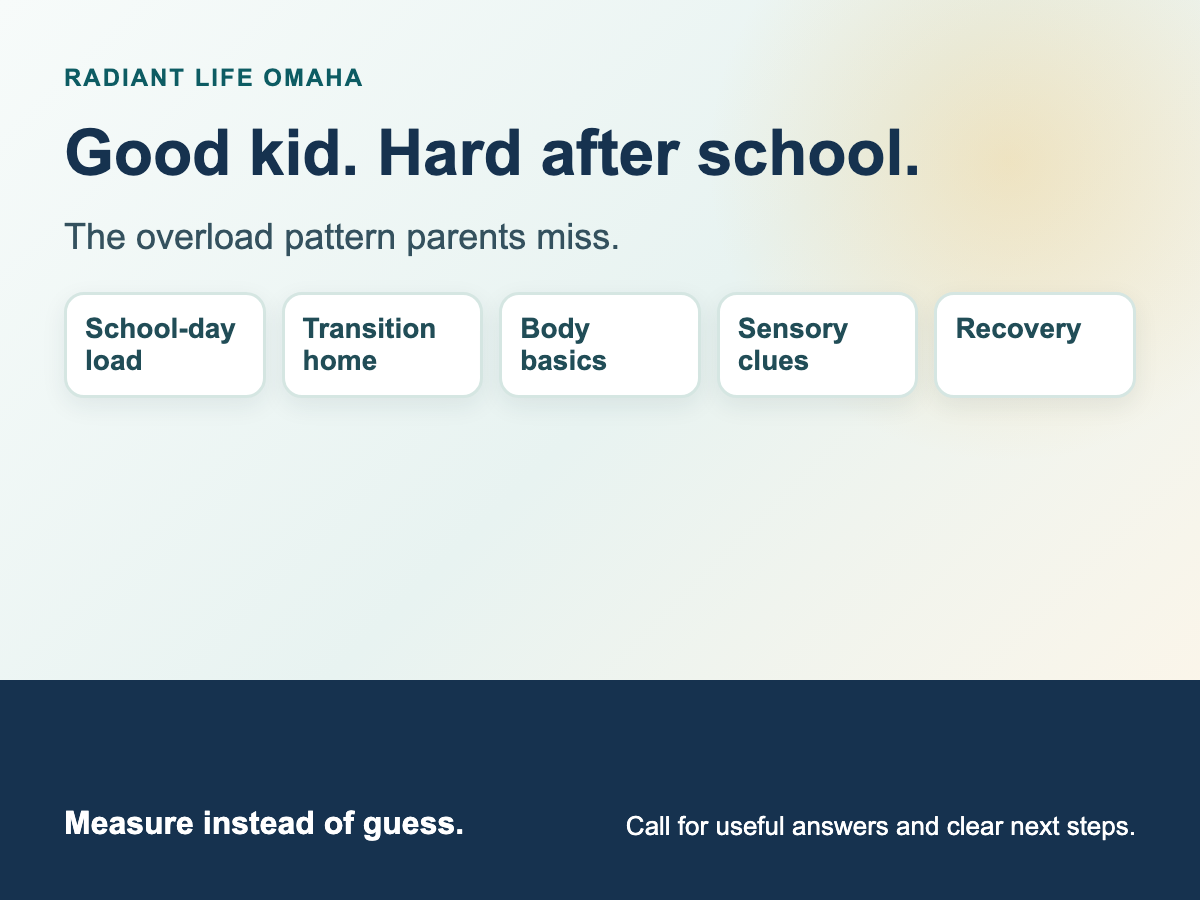
Five clues to track after school
- School-day load: Was there testing, a substitute, recess conflict, noise, a schedule change, or a hard subject?
- The transition home: Does the crash happen in the car, at the door, during snack, when homework starts, or when siblings enter the picture?
- Body basics: Track food, water, bathroom needs, movement, and sleep from the night before.
- Sensory clues: Watch for covering ears, chewing, crashing into furniture, hiding, refusing clothes, seeking screens, or needing pressure.
- Recovery: Notice what helps your child return to calm and how long it takes.
Why discipline alone may not solve it
Clear boundaries matter. Kids need loving structure. But if the nervous system is overloaded, more correction may only add another demand to a child who is already past capacity.
That is why parents often feel stuck. They try consequences, rewards, lectures, charts, and reminders, but the same explosion returns the next afternoon. When the root pattern is load and recovery, the family needs a plan that respects both behavior and biology.
What to try this week
Start with a low-pressure landing routine. Keep it simple enough to repeat.
- Offer water and a protein snack before homework or chores.
- Create ten minutes of quiet or heavy-work movement before conversation-heavy demands.
- Use one sentence instead of a lecture: “Your body worked hard today. Let’s reset first.”
- Delay non-urgent correction until the child is regulated enough to hear it.
- Track whether recovery gets shorter when the landing routine is predictable.
These steps do not replace needed clinical, educational, or mental-health care. They simply give parents a safer first experiment while they decide what the next conversation should be.
How Radiant Life Omaha helps families read the pattern
Radiant Life Omaha believes God made the body to work properly and to know peace and joy. The goal is not to excuse harmful behavior or blame school. The goal is to understand the child’s capacity and help the family find a wiser next step.
Radiant Life Omaha helps parents measure instead of guess, identify sensory and nervous-system stress patterns, help calm the sensory system and brain, track whether daily life improves, and guide the next step. Amount and timing of improvement vary and cannot be guaranteed.
Frequently asked questions
Does an after-school meltdown mean my child behaved badly on purpose?
Not necessarily. It may mean your child used all available regulation capacity during the school day and lost access to calm once the demand changed.
Should I ignore the behavior?
No. Boundaries still matter. The difference is timing and strategy: help the child return to calm, then teach and repair when they can actually participate.
When should we seek help?
Seek help when the pattern keeps repeating, becomes unsafe, affects school or family life, or leaves you feeling like you are constantly walking on eggshells.
Helpful sources: American Academy of Pediatrics parent guidance on emotional development and behavior; Child Mind Institute guidance on after-school restraint collapse and anxiety; CDC child development and mental health resources.
